
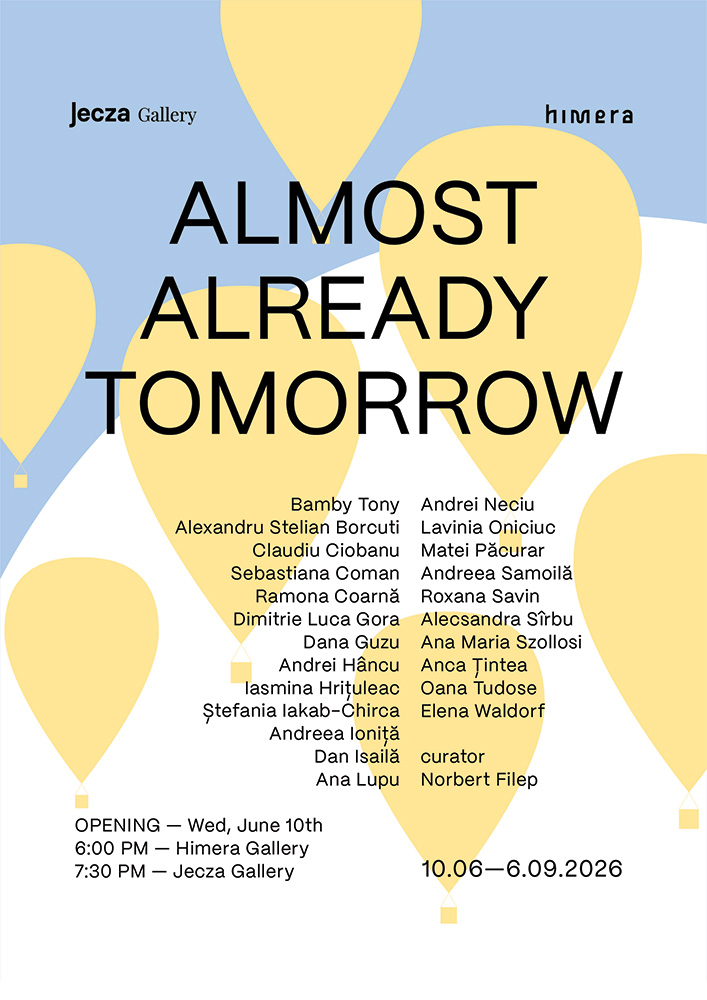
June 10th – August 30th 2026
Curated by Norbert Filep
The passage of time unfolds as a slowed clockwork mechanism when the traversal of the present oscillates between the moment that once was and the one yet to come. The understanding of the present state escapes almost entirely those who seek to synthesize and deepen this imprecise condition — once perceived, the present becomes past, and the instant drains definitively into the space of a time turned memory.
The space between the two temporal moments operates through a drawing left undefined by the sharpness of clock hands. Immutable, it dissolves into abstraction and becomes a site of questioning and curiosity. Almost Already Tomorrow reflects this nature of time in continuous flow — which is yet to come and which, in essence, has already passed in the very moment of its becoming conscious. That tomorrow already arrived as today carries the anxious character of lost time, left unfructified by the mechanical ticking of the clock. It reflects the swiftness of an accelerated world in which the sedimentation of knowledge is imperilled by continuous change.
The present trajectories mark multiple nuclei through which time is preserved by the actions of the artists, characterised by varied territories of media. Like cosmic situations, these practices subject the temporal flux to different perceptions — contracted or dilated by the processes of each artistic action.
Painting becomes a catalyst in this process of manipulating time. The fluidity of colour varies across the multitude of practices brought together in the exhibition: impastoed surfaces, successive layers, transparencies, and painterly gesture transform the quadrilateral of the support into the intricate meanders of brushwork, amplifying a temporal fluidity visible in the works of Dan Isailă, Lavinia Oniciuc, Ana Lupu, Ana Maria Szollosi, Andrei Neciu, Alecsandra Sîrbu, Alexandru Borcuți, Bamby Tony, Matei Păcurar, and Ramona Coarnă.
The spontaneity of the act of painting, the speed and freshness of the image generated through gesture — or, in contrast, the slow process of absorbing photographic reality through paint, present in the works of Claudiu Ciobanu, Dana Guzu, and Iasmina Hrițuleac — situates these practices within a continuous desire to fix time in the geography of the painted space.
At a conceptual level, duration becomes imperceptible. Time is no longer lived, but encapsulated. Dimitrie Gora’s ensemble of readymades, photography as a binding agent for ideatic development in the work of Andreea Samoilă, Roxana Savin, and Anca Țintea, printing through frottage and monotype processes by Sebastiana Coman, or the flat tone of an almost abstract painterly synthesis in the work of Andrei Hâncu — all of these conceal imperceptible fractions of the production process, where time is embedded within the invisible structure of the artistic gesture.
Space is the partner of time in general physics. In sculpture, this relationship becomes tangible: the works of Ștefania Iakab and Andreea Ioniță yield time to the viewer, and the reading of the work represents, at its core, a living concretisation of the space–time relationship.
The pixel long precedes the digital image. It operates according to the principle of mosaicism, through which multiple points of colour optically constitute formations that can be visually deciphered. In contrast to the digitally generated image, Elena Waldorf’s traditional mosaic fortifies the image, fixing it permanently within a construction through which slow production becomes the testament of an enduring time.
Oana Tudose’s textile occupies the opposite pole. Among the most vulnerable networks to entropic structures, it generates temporal fragility — the delicate surface of the material falls into a constant battle with the entropic nature of time, transforming ephemerality into an essential condition of the work.
Through the lens of 23 artistic practices, the exhibition Almost Already Tomorrow traces intragenerational relations and a reckoning with the constant changes of a new reality. Time returns, thus, to where it began, in the same drawing that outlines the fresh presence of the near future marked by the coming day — a living artefact, lost and rediscovered in the swiftness of everyday life.

Vernissage


Installation views


